

Computational Fluid Dynamics (CFD) Multiphase Mixing Analysis for Dual-Product Fuel Manifold
Executive Summary
In multi-product piping networks, managing fluid interfaces during product displacement is critical to preventing contamination. We conducted an advanced transient state Computational Fluid Dynamics (CFD) assessment of a fuel manifold handling sequential transfers of Diesel and Jet Fuel. The objective was to simulate a worst-case product transition scenario, evaluate fluid mixing, map dead legs, and precisely determine line clearance times to safeguard fuel purity.
The Challenge: Preventing Cross-Contamination in High-Volume Transfers
When a manifold transitions from transporting a high-density fluid (Diesel) to a lower-density fluid (Jet Fuel), fluid dynamics at the interface can cause significant mixing. The client required validation of "Sensitivity Case"—a worst-case density combination involving minimum density Jet Fuel (775 kg/m^3) displacing maximum density Diesel (845 kg/m^3) under a pump discharge pressure of 1200 kPa.

The engineering challenge focused on:
Quantifying Fluid Mixing: Accurately measuring the mixing zone at the interface.
Identifying Stagnant Zones: Mapping potential "dead legs" within the manifold where heavier Diesel could remain trapped.
Determining Clearance Time: Finding the exact time required to clear Diesel from the system to ensure standard operations could safely resume.
Engineering Methodology & Technical Approach
To capture the real-world physics of the transient fluid interface, our team implemented a high-fidelity multiphase numerical model:
1. Geometric Optimization & Meshing
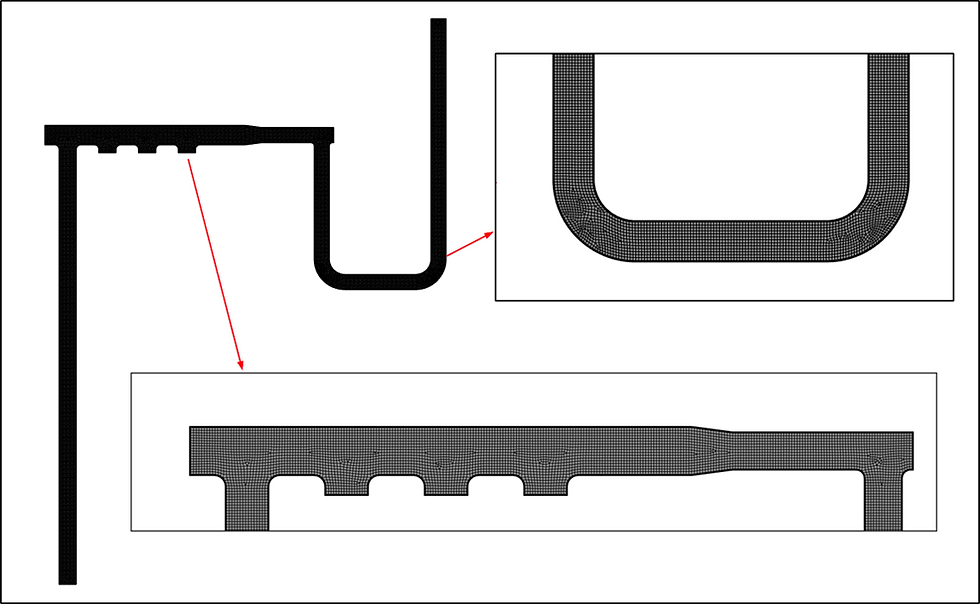
Boundary Effect Mitigation: Computational inlet and outlet lengths were strategically extended. This allowed the flow profiles to become fully developed and minimized numerical instabilities or backflow near boundary conditions.
High-Quality Discretization: The domain was discretized utilizing structured mesh alignment in critical zones, maintaining a minimum orthogonal quality of 0.2 to comply with rigid engineering simulation standards.
2. Physics & Governing Models
Multiphase Tracking: The Volume of Fluid (VOF) method was used to simulate the sharp, time-dependent interface between the immiscible fluids.
Turbulence Modeling: The Reynolds-Averaged Navier-Stokes (RANS) equations were coupled with the k-\omega SST (Shear Stress Transport) turbulence model to precisely capture shear-layer mixing along pipe walls and geometry transitions.
Boundary Conditions: Modeled under transient, incompressible flow conditions with a suction side pressure of 120 kPa and a discharge side pressure of 1200 kPa.
Results & Key Insights
Interface Propagation: The simulation successfully mapped the volumetric fraction layout from t=0 seconds through the transition cycle.
Dead-Leg Identification: The analysis successfully pinpointed stagnant flow zones within the manifold’s auxiliary branches, revealing precisely where Diesel pockets resist displacement.
Operational Clearance Metrics: The transient contours provided the client with the exact operational timeline required for complete Diesel clearance, allowing them to optimize flushing schedules and minimize product downgrading.


Business & Engineering Value Delivered
By leveraging advanced CFD analysis rather than relying on conservative empirical calculations, Elite Consulting Engineers provided the client with:
Risk Mitigation: Empirical proof of system performance under absolute worst-case operational density profiles.
Cost Savings: Optimized flush timing that reduces fuel downgrading and volume waste during product switchovers.
Regulatory Assurance: Rigorous, data-backed documentation validating the safety and structural integrity of the pipeline operating sequence.


Comments